 Photos: Courtesy of Rhode, Getty ImagesSave this storySave this story
The first male celebrity I ever interviewed about his beauty routine was James Franco at a Coach event when he was a brand ambassador, circa 2018. When I asked what his skin care routine was, he said, “Uhh, I use… Kiehls, I guess,” looking to this PR handler for the OK to say so. In those days, gaining access to male celebs at a beauty magazine like Allure involved a lot of polite declines from talent managers who expressed regret that their Marvel superhero client did not wish to disclose they used products that might be associated with such feminine things as washing their faces. All right, so they may not have said that directly, but I was perplexed by how allergic famous men seemed to be to any public-facing proximity to beauty.
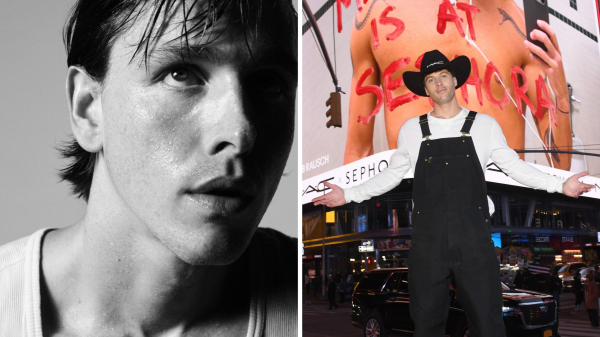
So imagine my sheer “Huh??” upon seeing an influx of men— straight, hunky ones—shilling for beauty brands in the past couple of weeks. Perhaps most splashy was reality TV star Rob Rausch’s sculpted abs and chest announcing “M.A.C. is at Sephora,” emblazoned in the brand’s iconic Ruby Woo lipstick in a mirror selfie. The campaign rollout followed with images of him wearing a black cowboy hat branded with the M.A.C. Cosmetics logo.
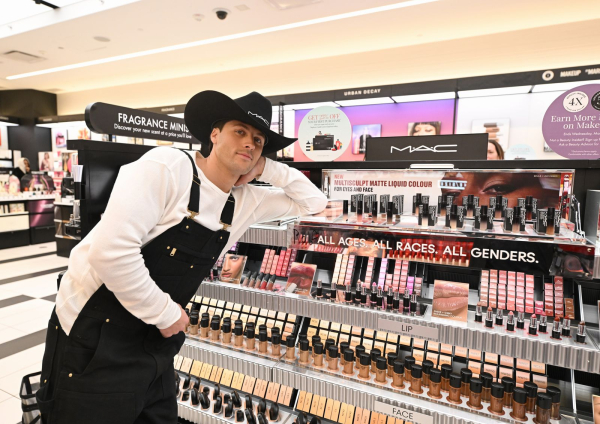
Rob Rausch during an appearance at Sephora.
Photo: Getty Images
Ed Westwick starred in Lâncome’s Juicy Tubes nostalgia campaign, monologuing as his Gossip Girl character Chuck Bass. Chad Michael Murray also participated in the campaign, reminiscing about his kissing scene in A Cinderella Story with co-star Hilary Duff. “Kisses are better with Juicy Tubes,” both men crowed in their respective ads. Actor Harris Dickinson starred as the face of Rhode’s Glazing Mist (the brand’s first male star in a campaign). More subtly, Milk Makeup teased the launch of its HydroGrip Gel Concealer on Heated Rivalry star Connie Storrie at the 2026 Golden Globes. And Merit Beauty posted a look breakdown featuring its products on his co-star Hudson Williams’s face as he carried the torch at the 2026 Milano-Cortino Olympics.
WWD has called this “Heartthrob Marketing,” as we’re seeing more and more desirable men being tapped to market products to female demographics in traditionally feminine markets, like beauty. Men, who ostensibly are not and would not be using these products themselves. Men, who aren’t even necessarily wearing the promoted products in the campaigns. Just men, in close proximity to a beauty product. I’d love to know how their talent managers strategized these appearances.
I’d also love to know: why?
I’ll admit, my instincts veer toward skepticism (sometimes cynicism if I doom-scroll too much). Engagement has no gender; this is true. But when it comes to the fandoms these “internet boyfriends” tend to attract, women will always prevail, and how. I immediately thought of the steep rise of romance in literature and cinema (romance remains the highest-grossing genre in literary fiction), and how both champion the HEA (“happily ever after” for the uninitiated), usually involving a heterosexual pairing.
What do women—particularly young women who are also discerning beauty consumers—want most? If you go by the countless TikTok videos, podcasts, and discourse revolving around dating culture, they want a handsome man who embodies conventional good looks (“in finance, 6’5, trust fund, etc.”), possesses emotional complexity and intelligence, and is secure enough with his masculinity to share his hypothetical girlfriend’s feminine hobbies (like beauty). This would be sweet if done in earnest. I love introducing men to skin care products and fragrances they get excited about.
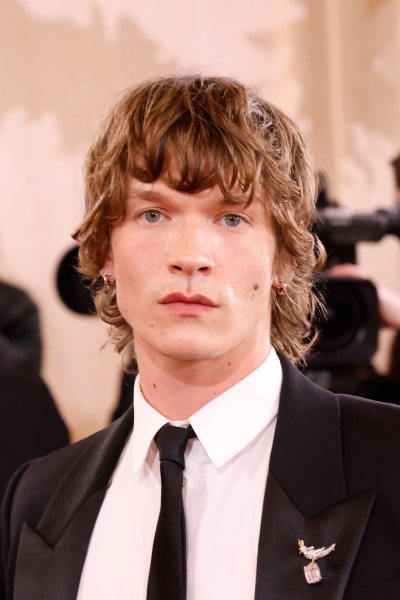
Connor Storrie at the 2026 Golden Globes, where he debuted Milk Makeup’s newest concealer.
Photo: Getty Images
But would I want to buy a M.A.C. Cosmetics lipstick from Rob Rausch’s abs? Would Love Island’s Jeremiah Brown, The Summer I Turned Pretty’s Sean Kaufman, Tyriq Withers, or Jesse McCarthy inspire a trip to Ulta Beauty? The brand’s holiday campaign featured these heartthrobs, captioned, “Hotties who shop at Ulta on Black Friday? That’s my type.” Why should Harris Dickinson’s dewy, freshly-misted visage cause me to hit “add to cart” any quicker than if it were featured on Hailey Bieber’s face instead?
For those born post-9/11, you’d be remiss not to notice the rather unsubtle nod to early aughts marketing that featured hunky guys idling in proximity to the thing being marketed. Abercrombie & Fitch (the hottest mall store of the first decade of this century, arguably) stationed shirtless male models like sexy sentries outside the entrances of its stores, luring in customers: the girls who wanted to get a closer look and maybe a cheeky wink from the models, and the guys who wanted to shop at the store most associated with being a hunky guy. Of course, the models themselves were not for sale, but the point was that surrounding your store (or brand) with hot dudes made the brand more attractive altogether.
The Y2K era was a strange contradiction of over-sexualizing young people while also upholding prudish values. The biggest fashion trends (low-rise jeans, visible whale-tail thongs, and cleavage galore) pushed the boundaries of how sexually suggestive a girl could dress to be considered cool and desirable, until she dared to act upon the suggestion, in which case she’d immediately be labeled a slut. Think Britney Spears debuting in a sexy schoolgirl outfit in her breakout single “Baby, One More Time” and then having to discuss her virginity pledge endlessly in interviews.
“Burnout from a decade of girlboss culture, the defeating reality of 'having it all,' and modern masculinity’s cultural crisis are making us miss simpler times. ”
Y2K nostalgia has been the marketing playbook in beauty for a while now, as Gen Z are rediscovering the styles that millennials and Gen Xers once wore. But as wistful as my mall-trawling days were, it’s hard not to reminisce with modern viewpoints, all of which find a lot of the misogyny-fueled, fatphobic, homophobic culture of that time really icky.
Nostalgia can be a soft place for your mind to rest for a bit of respite from the endless scroll of modern trappings. It can also be a quicksand pit, keeping us stuck in stagnation. Burnout from a decade of girlboss culture, the defeating reality of “having it all,” and modern masculinity’s cultural crisis are, of course, making us miss simpler times. And it’s manifesting in ways that overshoot into regression and gender essentialism (if the direction of our current political and social climate’s views on women’s bodily autonomy are any indication).
Are we nostalgia-ing too close to the sun? GLP-1s have made thinness injectable. Even eyebrows are getting thinner again. There have always been tensions between diet culture and desirability, which we’re now revisiting in a skinny-is-back flashback (it never went away, technically), even as gourmand scent profiles and dessert-themed beauty are more popular than ever. The physics of trend cycles has us revisiting an era that demanded women own their sexual empowerment via “10 ways to please your man” sex columns and weight-loss fad diets.
Trends reliably cycle back every 30 years, but a lot has changed in the last 10 alone, as we all were reminded by the recent “2016 is the new 2026” social media trend.
Instagram content
Empowerment marketing of the 2010s has given way to indulgence and desire. I think we’ve caught on that constant consumption is not empowering and is, in fact, deleterious to our mental and emotional well-being, not to mention our finances and the environment. Now that women are “empowered” in all conventional ways that we understand power to operate (largely through economic and social mobility), our spending power has brands questioning how to lure the so-called female gaze. Men may no longer be a requirement for women to have a life of security and comfort (and many of us are realizing that men may not be any additive benefit to our quality of life until they catch up with our expectations for true partnership). But that doesn’t necessarily mean we desire them any less (those of us who are attracted to men at all, anyway).
What comes after empowerment? Desire naturally follows when resources are secure, abundant even. And nostalgia prevails when we are uncertain about the future. Conditions for mentally checking out (or maladaptive daydreaming, according to my therapist) are ripe. If the fantasy of having it all involves an attractive partner—something beauty products have historically marketed themselves to secure—these hunky spokesmodels can stand in as some glimmer of that fantasy. Perhaps this new angle really is just dangling hot men as the carrot on a stick in front of a horse headed for Sephora, which is where M.A.C. Cosmetics arranged for a fan meet-and-greet with Rausch to fête their entering the retailer. And what’s a better fantasy to market than a potential meet-cute? That is, until Rausch’s newly hard-launched girlfriend brings us all back to reality.
Leave a Reply